
Four years after the Russian Federation’s invasion of Ukraine, the conflict ranks as the deadliest in the world, with a 1,200-km frontline and attacks frequently targeting essential infrastructure. More than 2,800 attacks have been recorded on healthcare facilities, and the health workforce has contracted by 14%. By 2025, nearly 13 million Ukrainians needed humanitarian assistance, including 9.2 million people needing health support.
Along the frontline and in remote rural areas, basic services have collapsed and emergency response has slowed significantly. With active combat zones receiving urgent operational attention, populations in rural areas remain marginalised within the humanitarian response.
EMERGENCY NGO is responding to the crisis with an innovative health response in rural communities near the frontline in Donetsk and Kharkiv oblasts, among the worst-affected regions in Ukraine.

The data are clear: the Ukrainians living in these rural villages are facing a lack of access to essential services. EMERGENCY is responding directly with a community-based healthcare model that improves access to care, complementing and reinforcing the existing system. We’re rebuilding and restoring infrastructure, but also training a sustainable network of nurses and community workers who can directly address the needs in their areas with a timely, effective response. Our ultimate goal is to bring healthcare services closer to those who need it most.”
Ali Msahir, EMERGENCY’s Field Coordinator in Ukraine
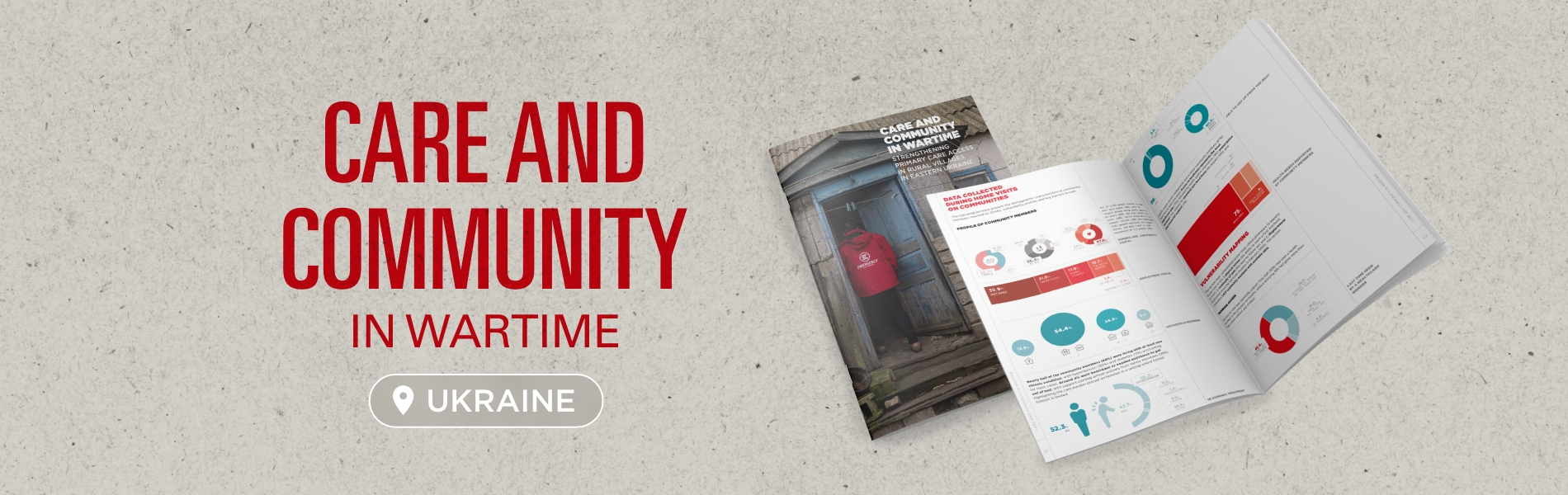
Based on data collected from thousands of home visits and nearly 400 surveys, the new report, “Care and Community in Wartime,” shows that even where fighting is not active, rural communities face mounting war-related barriers to care.
Two-thirds of community members (67%) reported at least one health concern, including nearly half (48%) needing treatment for chronic conditions like hypertension and diabetes. Access to medicine emerged as the most critical gap, cited by 75% of those with health needs.
Transportation constraints, workforce shortages and rising costs are straining the health system and sharply reducing access to essential services.
Nearly three quarters of respondents (73.7%) cite transportation as the primary barrier to access due to destroyed roads, fuel shortages and limited public transport. Economic pressures further contribute to barriers: 94.3% of households report higher medicine prices, 77.1% face increased transport costs and 59.5% have seen their income fall – all while less than 16% of community members are in salaried employment. The findings paint a stark picture of compounding barriers disproportionately pushing the most vulnerable further from care.

In the Donetsk region, EMERGENCY has installed, re-fitted or supported facilities including permanent clinics and semi-mobile units in 14 villages, ensuring comprehensive primary care and formal referral pathways to specialist treatment. Community Health Workers (CHWs) trained and deployed throughout the region are restoring access to care by operating door-to-door within their own villages. Empowered by accessible and secure digital tools, EMERGENCY’s CHWs are conducting needs assessments, providing first-line support, reducing the number of patients lost to follow-up and supporting navigation of available healthcare services.
Between June 2024 and October 2025, 11 CHWs conducted 10,842 home visits – an average of more than 20 per day – and arranged hundreds of other services, including general practitioner appointments, specialist visits and referrals to First Aid Points: reducing the distance between the population and access to healthcare.

During my interview, they asked if I could ride a bike. I said no, and my friends worried I wouldn’t get the job. Instead, I was hired and I learned to pedal. It wasn’t easy at my age, but now I cycle between four villages. My workday starts at 8:00 a.m. With my bike, phone and notebook, I visit residents to check on them and fill out my reports. Everyone knows me now; they often invite me in for coffee. Most of the people I care for are elderly and live alone. Beyond their many health problems, what they often need most is simply someone to listen to them.”
Natalia, a CHW in Donetsk oblast
People speak about this project very warmly. First, it increased the ‘feldshers’’ working hours, which benefits everyone. Then there are the semimobile containers and the renovation of existing facilities: in some villages there was no health point at all, and now people have a comfortable place where they can receive care. The clinics are also equipped with new furniture, medical equipment, supplies, consumables, diapers, and more. For remote villages, this is a real step forward—these small places are often overlooked.”
Head of Primary Medical and Sanitary Care Centre, Oleksandrivka Hromada, Donetsk Oblast
Every time I hear a plane, I feel afraid. So many pass by every day – fighter jets, helicopters… it’s a sound I’ve come to know all too well. I have lived alone for more than two years now. My children left, and they were right to do so: it is too dangerous here. The village was attacked shortly after the war began. Missiles exploded near my house, and the blast wave shattered every window […] I’ve lived without glass ever since – two whole winters like this, and it’s freezing inside.”
Lydia, 75 years old, Community member of Mykhailivka
The report concludes with key recommendations towards the international community and Ukraine’s authorities to increase access to care, including:
- guaranteeing flexible, multi-year financing for health
- prioritising health workforce capacity-building, health infrastructure and transport
- containing out-of-pockets expenses
- investing in community engagement and trained CHWs
- ensuring functional referral pathways and coordination of care
Building on successes highlighted in the report, EMERGENCY is progressively expanding its activities in Kharkiv oblast, extending support to another 13 clinics and 11 Community Health Workers, with a further two CHWs co-financed by local authorities.

“Every day we find ourselves talking to dozens of people and helping them bridge the gap that the conflict has created between them and access to healthcare,” says Luca Rifiorati, EMERGENCY’s Project Coordinator in Ukraine.
“EMERGENCY’s Community Health Workers are often the only people that community members feel comfortable confiding in. There is one constant across all their stories: after four years of war, they are desperate for the conflict to end so they can return to their former lives.”
EMERGENCY in Ukraine
In the municipalities of Oleksandrivka (Donetsk Oblast), Barvinkove and Blyznyky (Kharkiv Oblast), we run 14 clinics, reaching a total of 10,000 people.
Since October 2025, our intervention has further expanded in the Kharkiv region and has also seen the start of a screening programme for communicable diseases such as HIV, tuberculosis and hepatitis, which are highly prevalent in the country.
The report ‘Care and Community in Wartime’ analyses data on 3,600 beneficiaries collected by Community Health Workers during their daily activities and the results of 388 qualitative questionnaires administered to a sample of the population within 14 rural villages in Donetsk.